Kobakhidze, GD Ministers Visit UAE
Georgian Dream Prime Minister Irakli Kobakhidze and some of his cabinet members are visiting the United Arab Emirates from February 2 to 5.
It is Kobakhidze’s second official foreign trip this year and, again, to the UAE, after he visited Abu Dhabi in mid-January to attend Abu Dhabi Sustainability Week.
Kobakhidze arrived in Dubai on February 2. The Georgian Dream delegation, led by him, also includes Defense Minister Irakli Chikovani, Foreign Affairs Minister Maka Botchorishvili, Economy Minister Mariam Kvrivishvili, Justice Minister Paata Salia, Education Minister Givi Mikanadze, and Head of Government Administration Levan Zhorzholiani.
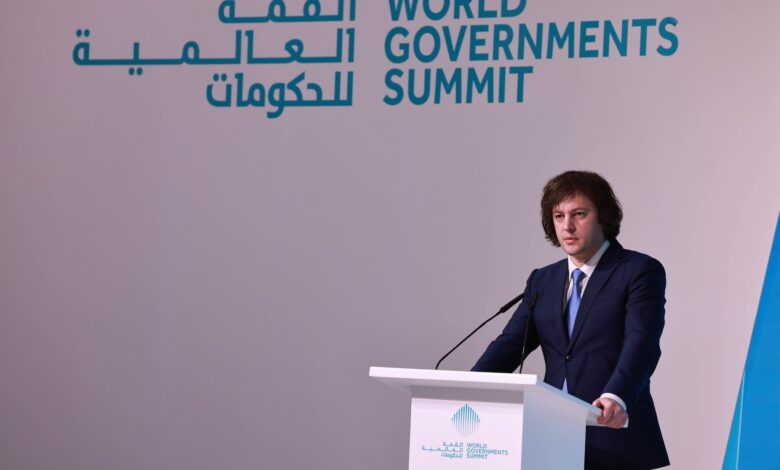
Irakli Kobakhidze is participating in the World Governments Summit (WGS), held in Dubai from February 3 to 5. He delivered a speech at the summit and took part in a roundtable discussion on the “future of investments.” He also held several bilateral meetings.
Georgian Dream government officials were, for the second consecutive year, not invited to attend the World Economic Forum in Davos, amid deteriorating relations with the country’s traditional Western partners.
Irakli Kobakhidze Addresses the Summit
Irakli Kobakhidze addressed the World Government Summit on February 3, saying that in today’s world, where trade routes are being “redrawn by geopolitics,” stability has become a “strategic asset” as he positioned Georgia as a reliable transit and investment hub “in an era of uncertainty.”
“We gather here in Dubai at a moment when the world’s commercial routes are being redrawn not by the invisible hand of market economics, but by the very visible fist of geopolitics,” Kobakhidze said in his opening remarks.
He pointed to disruptions caused by Russia’s full-scale war in Ukraine, noting that northern trade corridors linking Europe and Asia have been “severely affected,” while supply chains built over decades were “disrupted overnight.” He added that the Pacific trade routes are “increasingly politicized” amid what he called “Great Power tensions,” citing tariffs, sanctions, and strategic decoupling that have introduced “uncertainty to once-stable relationships.”
“This is not the economic globalization we once knew,” he asserted. “We are entering a new chapter one where geography matters again, where stability becomes a competitive advantage, and where the ability to maintain relationships across divides is not a diplomatic nicety, but an economic necessity.”
“In an era of uncertainty, stability itself becomes a strategic asset,” he said, calling for the development of “resilient trade” systems capable of withstanding “geopolitical shocks” while remaining open enough to sustain prosperity. He highlighted the importance of the Middle Corridor project, describing it as “no longer simply an option,” but “an imperative for global commerce.”
“The Middle Corridor, connecting East Asia to Europe through Central Asia, the Caucasus, and Turkey, offers something increasingly rare in today’s world,” he said, “A stable, reliable transit route that transcends geopolitical divides.”
He argued that in today’s environment, the ability to maintain “constructive relationships across political and strategic divides has become an economic advantage,” arguing that it should be matched by “well-developed infrastructure: modern highways, ports, and railways that enable goods to move not only faster, but reliably and predictably.”
Turning to Georgia’s domestic record, he said that over the past decade, the country has treated stability as a “deliberate policy choice,” noting that between 2021 and 2025, Georgia’s economic growth averaged 9.3% despite a period when “global trade slowed, and uncertainty intensified.”
“Georgia’s relevance is not defined by its location alone, but by what it has done with that location,” he said. “At a time when many were forced to react, Georgia chose to plan with ambitious projects,” he said, adding that the country has committed USD 7 billion to upgrading transport infrastructure and regularly spends 7-8% of GDP annually on capital expenditures.
He pointed to the railway modernization project, completed in December, arguing that it doubled capacity and substantially reduced transit time across the country. “Rail connectivity has been further strengthened through the Baku–Tbilisi–Kars railway, which provides a direct and reliable rail link between the Caspian Basin and international markets through Georgia.”
He also referenced the Black Sea Submarine Cable initiative, selected by the European Commission as a Project of Mutual Interest, which aims to “connect Georgia with European electricity systems and position the country as an important energy transit hub between Europe and the South Caucasus.”
In addition, Kobakhidze underscored the strategic significance of the Anaklia Deep Sea Port project, describing it as “a platform for scaling up transit volumes, attracting global shipping lines, and reinforcing the Black Sea’s role as a competitive gateway between Europe and Asia.”
“We believe that trade facilitation is as important as physical infrastructure; therefore, Georgia puts great emphasis on efficient border procedures, predictable transit, and streamlined cross-border flows,” he said.
“Peace creates predictability, predictability creates investment, and investment creates growth. What truly distinguishes Georgia is not only what we have built, but how we engage with the world,” he said, adding that free trade agreements with the European Union, China, Turkey, EFTA countries, and the CIS provide access to more than 2.3 billion consumers.
“In an age defined by rival blocs, Georgia has chosen connectivity over confrontation,” he said. “We do not ask partners to choose sides. We offer a platform where cooperation remains possible.”
Kobakhidze further pointed to the UAE-based Eagle Hills’ infrastructure project, hailed by the government as a USD 6.6 billion investment, arguing that it “signals that global capital sees Georgia not only as a transit point, but as a long-term partner for logistics, development, and innovation.”
“In a fragmented world, prosperity does not arise from walls; it arises from bridges,” he said. “Today, more than ever, the wealth of nations depends on those who build them,” he concluded. “Georgia stands ready to be one of those bridges.”
Meetings
On February 3, Irakli Kobakhidze met with Duma Gideon Boko, President of Botswana.
“The leaders discussed the importance of the non-recognition of Georgia’s occupied territories, as well as the political dialogue between the two countries,” the Georgian Dream government administration said.
On February 3, Irakli Kobakhidze also met with Masrour Barzani, Prime Minister of the Kurdistan Regional Government of Iraq.
“The parties discussed prospects for trade and economic cooperation,” the press release said, adding, “The discussion also focused on Georgia’s favorable geographic location, the potential of the Middle Corridor and the country’s role as an important regional and logistics hub.”
On February 3, Irakli Kobakhidze further met with Jasem Mohamed Albudaiwi, Secretary General of the Gulf Cooperation Council (GCC),
“The parties discussed relations between Georgia and the Gulf Cooperation Council, thereby noting that the further deepening of these ties would be facilitated by the conclusion of a Free Trade Agreement (FTA) with the GCC,” the press release said.
On February 4, Irakli Kobakhidze met with Shaikha Nasser Al Nowais, Secretary-General of the United Nations World Tourism Organization (UNWTO). Foreign Minister Maka Botchorishvili, Economy Minister Mariam Kvrivishvili, and Government Administration Head Levan Zhorzholiani also attended the meeting.
“The parties discussed the long-standing and fruitful cooperation between the Government of Georgia and UNWTO,” the Georgian Dream government administration said, adding, “The meeting also focused on steps taken by the Government of Georgia to further develop the country’s tourism potential.” The press release also said Kobakhidze invited Shaikha Nasser Al Nowais to visit Georgia.
On February 4, Irakli Kobakhidze also met with Đuro Macut, Prime Minister of Serbia.
“The parties noted the existing potential for deepening cooperation between the two countries across various sectors,” the official press release said, adding, “The importance of the Georgia-Serbia Joint Commission on Trade and Economic Cooperation was underscored as an effective format for further deepening sectoral relations. The decision to launch negotiations on a Free Trade Agreement (FTA) between the two countries was also highlighted as an important step toward further stimulating economic cooperation.”
On February 4, Irakli Kobakhidze also met with Marco Mariotti, President of Eastern Europe and the Caucasus region at Philip Morris International.
“The parties focused on Georgia’s favorable investment environment and the existing potential for cooperation in the fields of investment and technology,” the press release said, adding, “The discussion focused on the profound significance of peace, stability, and a predictable environment for business development.”
Georgia-UAE Memorandum of Understanding
On February 4, the governments of Georgia and the United Arab Emirates signed a memorandum of understanding (MoU) on cooperation in the exchange of government experience.
The document was signed by Levan Zhorzholiani, Head of the Government Administration of Georgia, and Maryam Al Hammadi, Minister of State of the United Arab Emirates and Secretary General of the UAE Cabinet.
“The MOU envisages the exchange of experience between governments in such important areas as strategic planning and the implementation of strategic documents,” Zhorzholiani said. “In this regard, we have an ongoing project that involves the introduction of an appropriate electronic monitoring system to achieve strategic objectives.”
More to follow…
Also Read:
- 25/11/2025 – ‘6.5 Bln Investment’ By Emirati Company Draws Questions, Controversies
- 20/09/2025 – Ivanishvili, Kobakhidze Host UAE Leader in Tbilisi
- 27/01/2025 – Georgian Dream PM Kobakhidze Visits UAE
- 11/10/2023 – Georgia and UAE Sign Comprehensive Economic Partnership Agreement (CEPA)